IT support for small businesses: the four models, and how to choose
If you search for "IT support for small businesses", you get agencies selling hours, and you get articles defining what IT support is. The problem is that none of them tell you what you actually get for your money — because it is four completely different services that all go by the same name.
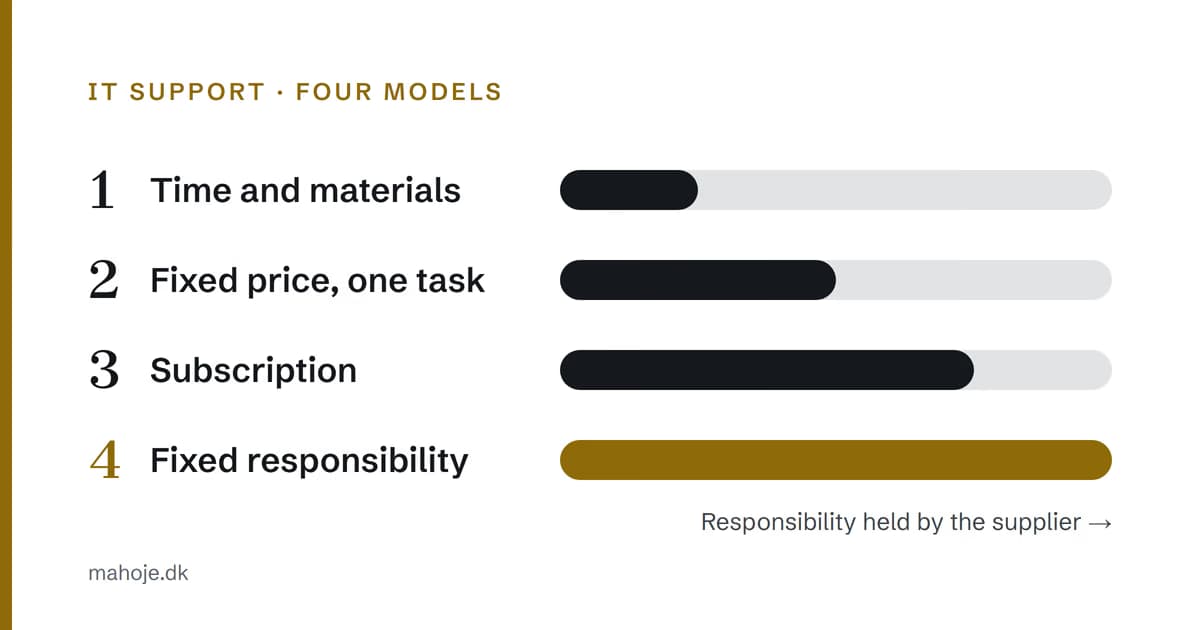
Time-and-materials delivery isn't the same as a subscription. A subscription isn't the same as someone taking full responsibility. And the difference is exactly where most small businesses burn money.
Here are the four models, what they cover, and what to ask before you choose.
Model 1: Time and materials
The classic: you call, they check, you pay for the time it took.
It is the easiest one to start with, and the easiest one to make expensive. Because it charges for your need at the moment you call. A fault that takes twenty minutes to find and a fault that takes two hours are exactly the same kind of problem for you — but the expensive one is the one that hurts most.
That isn't an argument against the time-and-materials model. It fits well when you know there is a concrete problem and you want it solved. It fits badly when you call because you are worried something is wrong.
Model 2: A fixed price for one thing
You describe the one task — "the website isn't sending order confirmations", "we need a form that actually works in every browser" — and you get a price for it.
It is the best start if you don't know where it is going wrong, but you know that something isn't working. And it is the model where you can hold the supplier to the task: it is either done or it isn't.
It is also the only one of the four where the price makes sense to compare across suppliers, because they are all selling the same thing.
Model 3: A subscription with a fixed amount
You pay a fixed amount a month for an agreed scope: a certain amount of support, updates, backups and monitoring.
Here the question becomes what is included. A subscription without a written list isn't a subscription — it is an hourly bill with a different invoice. And that is the mistake that leaves people stuck in something they can't get out of.
Ask three things before you sign:
- Is there a written list of what is covered?
- What happens if I use more than the agreement?
- What happens if I use less?
The third question reveals whether the supplier has planned for you actually using the agreement — or only for selling it.
Model 4: Fixed responsibility
The only model where the responsibility sits in one place and stays there.
You don't have an IT team, but you have a problem, and it is either solved or it isn't. It covers both the expected — updates, faults, backups — and the unexpected: the server that hangs on a Tuesday evening and costs you a customer's trust.
It is the most expensive model, and it is the one that assumes things will break now and then. If you expect a problem every day, it isn't the one you need — that is a mistake that ends with you oversizing.
What actually breaks
Whichever model you choose, it is the same eight things that fill the calendar at most of the small businesses I have worked with:
- The website is down. Hosting, domain, SSL — it isn't a WordPress problem, it is an operations problem.
- The backup has never been tested. Everyone has a backup. Few have tried to restore it.
- Plugins and themes are updated, but not tested. The update can take the website down.
- Forms that don't work. The most underestimated fault, because it hits revenue directly.
- A hacked website. It rarely happens. It is rarely something that costs more than an hour — when it does happen.
- Someone has access who shouldn't. The most dangerous and the most common.
- Printers that behave differently since the last update. The most dangerous and the least visible.
- Someone falls ill, and the only person with access is on holiday.
The list isn't random. It is what happens when nobody has the responsibility — because everything above is thankless work, and thankless work is something nobody does.
How to check a supplier
Before you commit to anything, you need to be able to answer these four. Not because they are difficult, but because the answers tell you who you are dealing with:
- Who do I call at 10 pm if the website is down?
- When did you last restore a backup from scratch, and how long did it take?
- What is your response time for a fault that stops sales?
- What happens to the access when the collaboration ends?
The last question is the one people forget. If the answer is "we'll discuss it", get it in writing before there is anything to discuss.
What it costs
Here I would rather link to the figures than repeat them, because they change.
The whole pricing structure is on the pricing page: from the lowest level, which covers the technical side and keeps it running, to the level where responsibility for the whole stack is fixed. And if you want to see what it covers in practice, it is on maintenance and technical partner.
What I will say here is that the hourly rate isn't the figure to optimise for. It is the easiest figure to find and the smallest figure that matters.
A supplier at DKK 900 an hour who spends two hours on every task costs more than one at DKK 1,200 who spends one. And one who takes responsibility costs more than both — because they are responsible for their own speed. That is exactly why it is more expensive.
Conclusion
If you have a concrete problem, get it solved at a fixed price. It is the easiest thing to go into, and the easiest thing to hold a supplier to.
If you have an ongoing need and no one internally with time for it, consider a subscription with a written list.
And if you are in the situation where you don't know whether there is a problem — that is because you have no one whose responsibility it is to find out. That is the model called technical partner, and it is built on the premise that you don't have an IT team.
It isn't the most expensive choice. It is the only one where you don't have to keep an eye on whether it works.
