CTO is one of those titles you see on LinkedIn and in start-up press releases but rarely see explained. It is used for everything from the first developer in a new company to a director with a hundred people reporting to them. That makes it hard to know whether it is something a smaller business should think about at all.
In this post I explain what CTO means, what the role consists of, how it differs from a CIO and an IT manager, and when a business with 5 to 50 employees needs it. I sell an external CTO service myself, so I have an interest in the subject. That is why the definitions and figures are linked to sources outside mahoje.dk, collected at the bottom. The salary figures are Danish, because that is the market I work in.
In short
- CTO stands for Chief Technology Officer. It is the person in the management team with overall responsibility for the company's technology strategy (Evidi). In Danish it is usually translated as teknisk direktør, technical director.
- A CTO does not necessarily write code. The role is about making and justifying the technical choices, keeping track of risks and making sure the technology follows the business.
- A CTO and a CIO are not the same. A CIO typically works with internal IT day to day, while a CTO makes the overarching choices about the technology (Wikipedia).
- A full-time CTO is expensive. Statistics Denmark has no CTO category, but the two closest management groups were at roughly DKK 94,000 to 101,000 a month in 2024 (Statistics Denmark).
- Most smaller businesses need the function, not the position. It can be covered in four ways, which I go through below.
What does CTO mean?
CTO is short for Chief Technology Officer. Literally, the person with top responsibility for technology. In its technology glossary, the Danish consultancy Evidi describes a CTO as "the top executive responsible for developing, implementing and managing the company's technology strategy" (Evidi).
English Wikipedia describes the role as an executive responsible for the organisation's technical operations, overseeing research and development and advising the chief executive on technology (Wikipedia). The title emerged in large companies in the late 1980s, as IT and internet companies grew and technology became part of the product itself (Wikipedia).
In Denmark the title is not in Den Danske Ordbog, the standard Danish dictionary, and there is no fixed Danish translation (Den Danske Ordbog). In practice Danes use the English abbreviation, and when it is translated it usually becomes teknisk direktør or teknologidirektør.
What matters is not the word but the responsibility. A CTO is the person who can answer questions like: why do we use this system? What happens if it goes down? And what should we choose the next time we build something?
What does a CTO do?
The tasks depend on the size of the company, but the same five things keep coming up.
- The technical choices. Build or buy? Which platform should the website or webshop run on? Which supplier should we use? A CTO makes the choices, writes down the reasoning and stands by them.
- The long-term plan. Evidi lists long-term plans for technology and innovation that match the business goals as a core task (Evidi). In a smaller business that can be as simple as a list of what needs replacing over the next two years, and what it costs.
- Architecture and quality. How the systems fit together, where the data lives, and whether what gets built will last. This is where technical debt is either kept down or allowed to grow.
- Risk and security. Backups, updates, access, who has the passwords, and what happens if a supplier disappears. It is dull work, until the day it isn't.
- New technology. Judging whether AI, new cloud services or automation, for example, make sense for your particular business, and whether the suppliers' offers are sensible (Evidi).
Note that none of these requires the CTO to write the code. In a start-up they often do, but in an established business the role is first and foremost leadership and judgement.
CTO, CIO and IT manager: what is the difference?
The three titles are often mixed up, and in a smaller business it is often one person doing all of it. But the responsibilities differ.
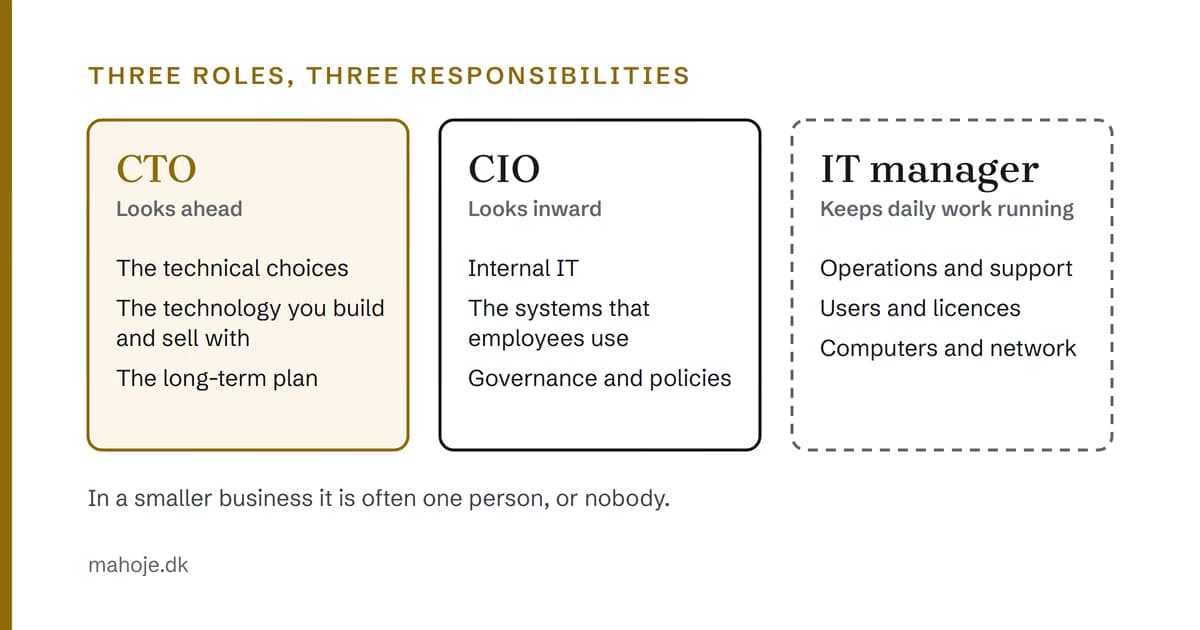
The CIO (Chief Information Officer) is the top executive for the company's information technology and systems (Wikipedia). The focus is inward: the systems employees use, and how they are governed and used in the business.
The CTO focuses on the technology itself, often what customers see. Wikipedia sums up the difference this way: CTOs are concerned with the technology itself, often customer-facing, while CIOs are more concerned with how it is used and governed in the business (Wikipedia). The article on the CTO says the same from the other side: the CTO makes the overarching choices about the technology, while the CIO works with the IT staff on day-to-day operations (Wikipedia).
The IT manager is not an executive title. It is usually the person who keeps the day-to-day running: computers, users, licences, support and the network. Many smaller businesses buy that part from an IT supplier.
For a smaller business, the most important line runs between internal IT and the technology you earn money with. The website, the webshop, the booking system and the integrations with the accounting system are often not on the IT supplier's desk. They are on the CTO's desk, and that desk is often empty.
A CTO in a start-up and in an established business
The role looks very different depending on where the company is.
In a start-up the CTO is often one of the founders and the first person to build the product. Here the title mostly means that the person owns the technology, and they typically write much of the code themselves. As the company grows, the job slowly shifts from building to hiring, prioritising and leading.
In an established smaller business, say a trade business, a consultancy or a webshop with ten employees, the product is not software. Technology is a tool, but an important one. Here the CTO function is about choosing well, holding suppliers to their agreements and making sure nothing grinds to a halt because the key sits with one person who has left.
In a large company the CTO sits on the executive board. Wikipedia notes that in companies where technology is not the core business, the CTO typically reports to the CIO, while the two are on the same level in technology companies (Wikipedia).
This post is written for the middle group. It needs the judgement, but not an executive.
What does a CTO cost?
Statistics Denmark does not publish pay for a position called CTO. Its wage statistics use job functions (DISCO codes, the Danish version of the international ISCO classification), and the two closest management groups are:
- Management of commercial research and development (DISCO 1223): DKK 100,994 in standardised monthly earnings in 2024 (Statistics Denmark).
- Management within information and communications technology (DISCO 1330): DKK 94,160 in 2024 (Statistics Denmark).
Standardised monthly earnings are Statistics Denmark's hourly earnings converted to a month with a 37-hour working week (Statistics Denmark). The figures cover all managers in the two groups, not just those with a CTO title. They do show the level, though: a full-time technical leader costs around DKK 100,000 a month in Denmark, before recruitment, office and equipment.
That amount makes sense when technology is the product itself. For a business that needs a few hours of technical leadership a month, it is not the right sum to be doing. That is the reasoning behind my Technical partner service, which I describe below.
When does a smaller business need the CTO function?
It is not the number of employees that decides it. It is how dependent the business is on its technology, and whether anyone owns it. These are the signs I look for:
- Nobody can say who to call if the website or webshop goes down on a Friday afternoon.
- You get quotes from agencies and suppliers that you cannot assess. Is the price reasonable? Is the solution the right one? Who do you ask?
- The suppliers point at each other. The web agency says it is the hosting. The host says it is the theme. Nobody owns the whole.
- There is a digital idea that has been on the list for more than a year, because nobody has time to work out how to do it.
- Access is scattered. The domain is registered in a former employee's name, or the passwords exist only in one person's head.
- Projects are delayed, and costs grow faster than results.
The last point also comes up at TechCXO, which sells part-time CTO services in the US. They list delayed projects, development costs out of step with progress, and technical decisions without a clear link to the business as typical signs (TechCXO).
If you recognise two or three of these, you do not necessarily need a new supplier. You need someone who owns the technical decisions. That is where it makes sense to think in terms of a CTO function.
Four ways to get the CTO function
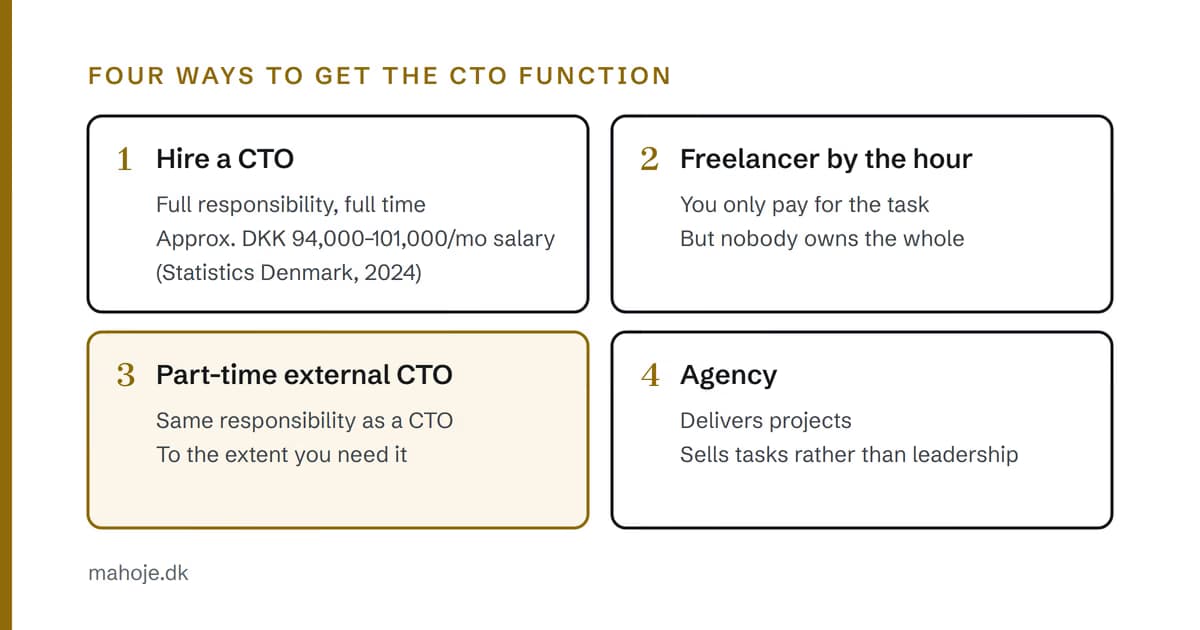
1. Hire a CTO. You get a person who works only for you and knows the business inside out. It is the right solution when technology is the product itself and there is enough work for a full-time position. Otherwise you are paying for too much capacity.
2. Use a freelancer by the hour. Fine for well-defined tasks. The downside is that the freelancer solves the task you ask for, and does not necessarily ask whether it is the right one. Responsibility for the whole stays with you.
3. Rent a part-time external CTO. Often called a fractional CTO: an experienced technical leader you rent part of the time when a full-time position is not the right step yet (TechCXO). The person has the same responsibility as an employed CTO, but only to the extent you need.
4. Leave it to an agency. An agency can deliver large projects with several disciplines. But an agency typically sells projects and hours. The question of what you should not build is not always the one the agency has most interest in asking.
There is a fifth option, which is often the right one for the smallest businesses: a fixed maintenance plan, where someone keeps the systems updated and secure without a CTO being involved.
What I offer
I sell model 3 under the name Technical partner. It costs DKK 15,000 a month excl. VAT. There is no commitment period, and you can cancel to the end of the current month plus 1 month. You send the tasks in the order you want them, and I take them one at a time. It covers web, servers, mail, AI, payments, security and SEO, so you have one place to go.
If what you mostly need is for the website to be kept running, one of the maintenance plans from DKK 2,500 a month excl. VAT is often enough. If you are unsure, start with the free website check (in Danish). It shows how your site is doing on speed, security and SEO, and it is a good starting point for talking about what is missing. All levels are on the pricing page.
Frequently asked questions
What does CTO stand for?
CTO stands for Chief Technology Officer: the person in the management team with overall responsibility for the company's technology, its technical choices and its technical development. In Danish it is usually rendered as teknisk direktør (technical director).
What is the difference between a CTO and a CIO?
A CIO (Chief Information Officer) is usually responsible for the company's internal IT, the systems employees use day to day. A CTO is responsible for the technology the company builds and sells with, and for the long-term technical choices. In smaller businesses it is often the same person, or nobody.
What does a CTO earn in Denmark?
Statistics Denmark has no category called CTO. The two closest management groups in its wage statistics, management of commercial research and development and management within information and communications technology, had standardised monthly earnings of roughly DKK 101,000 and DKK 94,000 in 2024.
Does a small business need a CTO?
Rarely full time, but often the function. If the business depends on its website, webshop or internal systems and nobody owns the technical decisions, you are missing what a CTO does. It can be covered by a part-time external CTO or a permanent technical partner.
What is an external or fractional CTO?
An experienced technical leader the business rents part of the time instead of employing. The person has the same responsibility as a CTO, meaning the technical choices, the suppliers and the risks, but only to the extent the business needs.
Sources
All sources were read on 2 October 2026.
- Evidi: Chief Technology Officer (CTO), technology glossary (in Danish): evidi.com
- Wikipedia: Chief technology officer: en.wikipedia.org
- Wikipedia: Chief information officer: en.wikipedia.org
- Den Danske Ordbog: search for "CTO" (in Danish): ordnet.dk
- Statistics Denmark: LONS20, earnings by job function, 2024 (DISCO 1223 and 1330, standardised monthly earnings, all sectors): statistikbanken.dk
- Statistics Denmark: Standardised monthly earnings (documentation, in Danish): dst.dk
- TechCXO: Fractional CTO: techcxo.com