When do you outgrow a maintenance plan and need a technical partner?
Most business owners start in the same place: they know their website needs looking after. Updates, backups, peace of mind. A maintenance plan solves that.
But after a while, some of them discover that they need more than peace of mind. They need direction. Someone who can see the technical side all the way through — and not just keep it running, but move it forward.
The question is: when have you reached that point?
Maintenance and a CTO are two different things
Let's get the difference straight first:
Maintenance is about keeping things running. Updates, security, backups, speed, monitoring. It is peace of mind — you know the site won't go down and that you won't get hacked. It is indispensable, but it doesn't move anything.
A technical partner (CTO as a service) is about moving things forward. Which technology should you bet on? When does it make sense to build something new instead of patching the old? How do you prioritise between security, features and speed? That is strategy — and it takes someone who knows your business.
You may well need both. But most people start with maintenance and only later discover that they are missing the other part.
The signs that maintenance is no longer enough
How do you know it is time to switch? These are the clearest signs:
You have ideas, but no one to make them happen. You know you ought to automate something, streamline a process or build a new tool. But a maintenance plan doesn't pay for that kind of work. So the ideas stay on the shelf.
Your site is stable, but your competitors are pulling away. Your site works flawlessly. But your competitors have added AI search, a better user experience, faster load times. You are standing still because "it works". And it does — yesterday.
Technical decisions keep getting postponed. Should we switch CMS? Should we build a webshop? Should we bet on a new platform? Without a technical partner, decisions like these get put off until they are urgent — and more expensive.
You have no idea whether you are paying too much. A maintenance plan has a fixed price. But is it the right solution for your size? Or are you paying for something you no longer need — or too little for what you actually need?
Nobody ever says "no" to you. It sounds odd as a problem, but it may be the most important point. A good technical partner pushes back on bad ideas. A maintenance supplier says "we can do that" — for a fee. The difference is whether you have someone who thinks along with you as part of the team, or someone who just takes orders.
What a technical partner gives you that maintenance can't
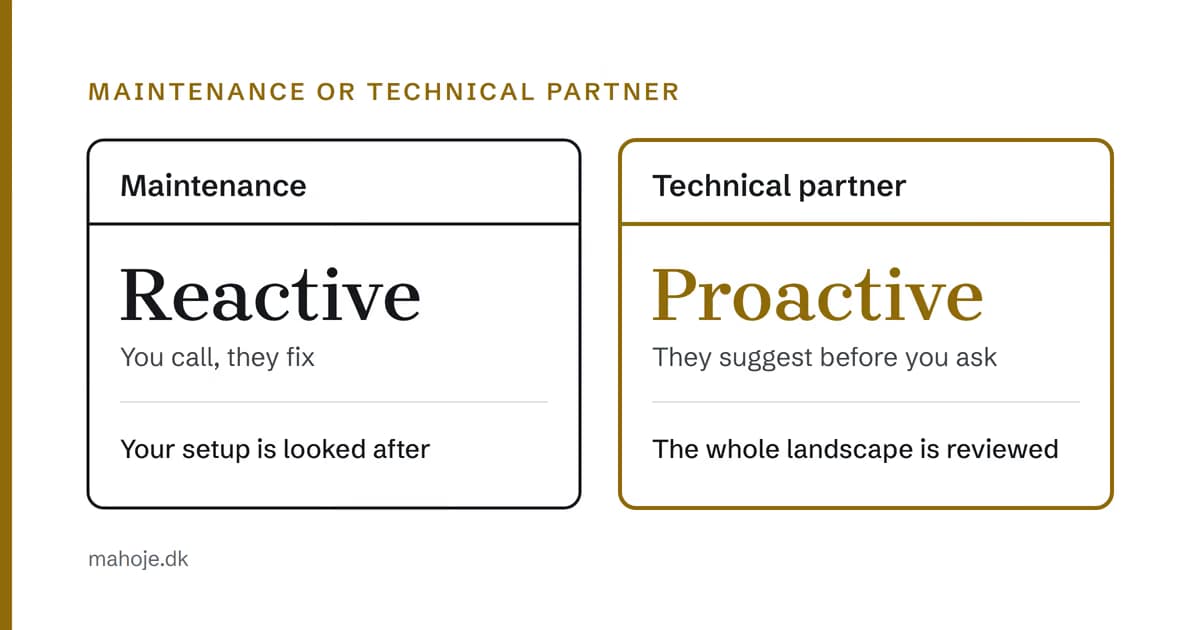
When you move from maintenance to a technical partner, you move from reactive to proactive:
| Maintenance | Technical partner | |
|---|---|---|
| Tasks | Updates, backup, monitoring | Strategy, architecture, prioritisation |
| Pace | Reactive — you call, they fix | Proactive — they suggest before you ask |
| Decisions | Technical choices are made by you alone | Shared decisions with expert input |
| Scope | Your existing setup is looked after | The whole technical landscape is reviewed continuously |
The biggest difference is that a technical partner is responsible for the outcome — not just for keeping the clock running. That changes everything about how the priorities look.
The numbers
Can you have both? Yes — and that is actually what I recommend most often:
- Light (DKK 5,000/month): baseline peace of mind — updates, backups, monitoring
- Drift+ (DKK 10,000/month): more scope, a quarterly report, ongoing improvements
- Technical partner (DKK 15,000/month): the CTO work — strategy, architecture, prioritisation, the whole stack
Many start on Drift+ and add the technical partnership on top when they need the strategic input. Others combine Light with the technical partnership and use the DKK 5,000 to get maintenance running automatically, so the partner time goes to the things that move the business.
There is no single right answer — only the one that fits where you are right now.
