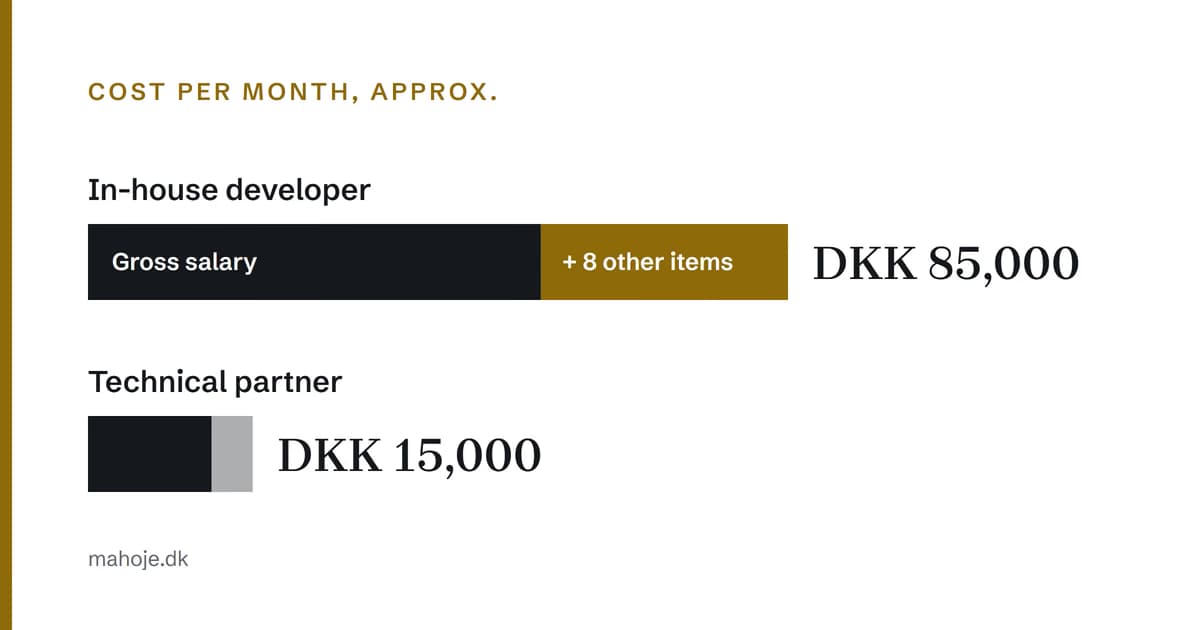
What does an in-house developer really cost? (Compared with a technical partner)
At some point, most small and medium-sized businesses face a choice: should we hire a developer? Or should we sign an agreement with a technical partner?
At first glance the answer seems obvious — an employee is surely "cheaper" than DKK 15,000 a month, isn't it?
Yes, if you only count the salary. But that is far from the whole picture.
The true cost of an in-house developer
The figures below are for Denmark, where I work. An average full-stack developer in Denmark costs around DKK 50,000–65,000 a month in gross salary. But that is only the start:
| Cost | Price per month (approx.) |
|---|---|
| Gross salary (full-stack, 3–5 years' experience) | DKK 55,000 |
| Pension (10–15%) | DKK 6,000 |
| Holiday pay (12.5%) | DKK 7,000 |
| Employer's ATP (Danish labour-market pension), parental leave fund etc. | DKK 1,000 |
| Recruitment (spread over 2 years) | DKK 3,000 |
| Equipment, licences, tools | DKK 2,500 |
| Courses, conferences, professional development | DKK 1,500 |
| Sickness, holiday (apart from the 25 days) | DKK 4,000 |
| Management cost (1/8 of a manager's time) | DKK 5,000 |
| Total per month | ~DKK 85,000 |
And that is before you hire a more experienced profile, before you pay for extra consultants at peak times, and before you count the cost of getting it wrong.
What do you get for the money?
An in-house developer can perhaps spend 60–100% of their time on what you actually need. The rest goes on meetings, internal communication, onboarding new colleagues, getting to grips with your business and waiting for answers.
With a technical partner, on the other hand:
- You only pay for what you use — typically DKK 15,000 a month, covering both operations and strategy. If that doesn't cover your needs, the alternative is a complete solution from DKK 20,000.
- No recruitment cost — you don't pay three months' salary to a recruitment agency when the employee changes jobs after 14 months (the average tenure for a developer in Denmark is ~18 months).
- No management burden — your own time as managing director or manager doesn't go on performance reviews, sickness absence meetings or professional sparring.
- Access to a broader range — one employee knows a lot about their own stack. A partner should be able to assess across WordPress, headless CMS, AI integration, hosting, security and business strategy.
- No termination risk — you are not left with half a salary during a notice period or with lost output while someone works their notice. A partner agreement can be changed or ended at short notice, typically the current month plus one month.
Where is the line?
There are definitely scenarios where an employee makes sense. You should hire if:
- You need a full-time presence — 160+ hours a month in core hours
- Your business is the technology — not just a tool
- You have a whole stack to build from scratch over 6+ months
- You have an internal manager who can direct and prioritise the developer's time
But for the vast majority of small businesses — companies with 2–30 employees where tech is a means, not the product — a technical partner gives considerably more value. The difference is that you buy expertise, not presence.
What do you lose by waiting?
The biggest loss from choosing the "cheapest solution" is rarely the money. It is the business you don't get to run because you lack the technical capital:
- Features that could have given you a competitive advantage
- Automation that could have saved you 20 hours of manual work a week
- A technical architecture that could have made you ready for growth
- AI integration that could have opened up new revenue streams
A technical partner is not a saving on the bottom line. It is an investment in moving it.
