Why one person with AI can deliver what used to take a whole team
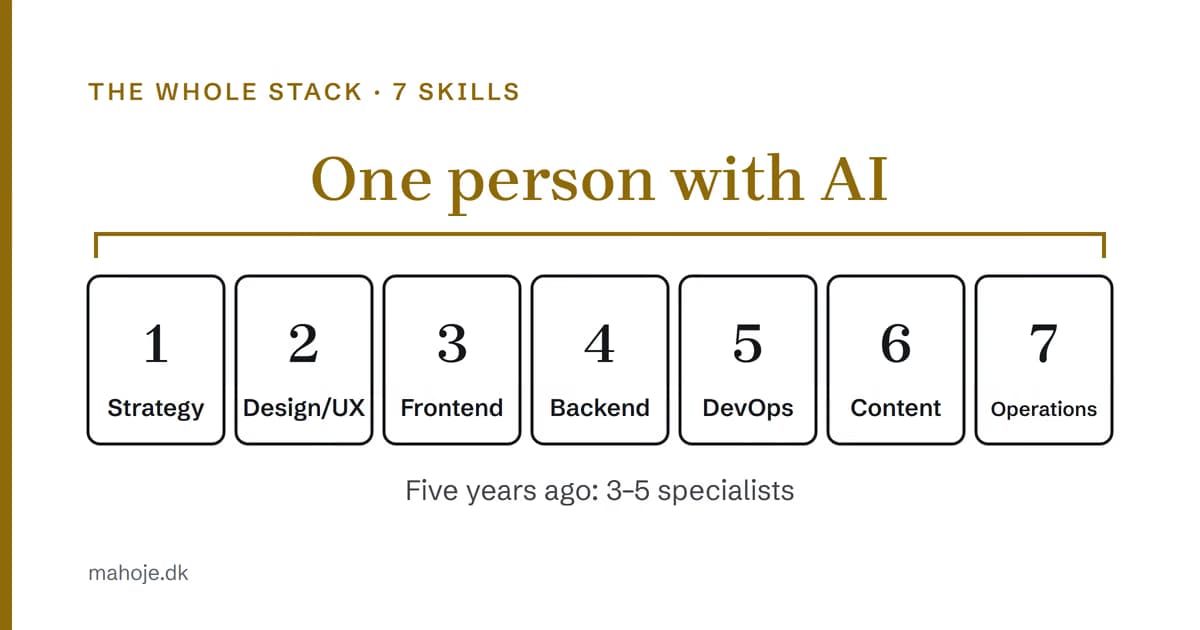
Five years ago it was standard for a web project to need 3–5 specialists. Today I deliver the whole stack myself — from strategy to operations — with AI as a force multiplier. Here is how, and why it is better for you as a client.
Spoiler: it isn't about saving money. It is about removing the bottlenecks in a traditional team.
What "the whole stack" covers
A typical digital product (website, web app, integration) touches at least seven different skills:
- Strategy: what should the solution do, what is the business value, what is the first step?
- Design/UX: user journey, layout, visual identity, conversion optimisation
- Frontend: code that runs in the browser — responsive, accessible, fast
- Backend: server logic, APIs, databases, integrations
- DevOps: hosting, deployment, monitoring, security, CI/CD
- Content: copy, SEO, structure, images
- Operations: maintenance, updates, backups, support
In a traditional agency, each of these is a permanent specialist. Three of them have meetings every week to coordinate. When the frontend developer is off, the frontend work stops.
Before AI: specialisation was a necessity
Specialisation didn't arise because it was efficient — but because the technology was so complex that nobody could cover more than one domain. A backend developer knew SQL and server configuration but didn't touch CSS. A designer understood usability but couldn't code.
The result: 3–5 people on a project, each with 50% meeting and coordination time. Actual development time: perhaps 30% of the total budget.
What AI changes
AI doesn't change the need for judgement, experience or business understanding. It changes how long routine work takes. And routine work makes up 70–80% of a developer's day.
Here are concrete examples from my working week:
1. Code: writing → reviewing
Before: write all the code from scratch, look things up in the documentation, debug for hours.
Now: AI generates 80% of the code from a short spec. I review, adapt and approve it.
Time saved: 3–4× on coding tasks. The quality is higher because the AI doesn't make typos and has read all the documentation.
2. Debugging: guesswork → precision
Before: a server returns a 500. You look in the logs, google the error code, try things out. Hours of it.
Now: the AI gets the logs, config and code. "What is the cause?" — an answer in 10 seconds. I verify and fix it.
Last year a contact form lost leads for six months because a POST request was being sent incorrectly. It took AI 2 minutes to find, after a developer had searched for 3 days.
3. Design: mockup → review
Before: a designer makes mockups in Figma. A developer translates them into code. Changes: back to Figma, export, implement.
Now: AI generates UI code from a description. I adjust the design in the browser with CSS prompts. Done in one day instead of a week.
4. DevOps: manual → scripted
Before: setting up a server, SSL, deployment and backups took hours per task.
Now: AI generates scripts, Docker configuration and GitHub Actions. I inspect the output, test it in a staging environment and put it into production.
5. Security: annual audit → continuous monitoring
Before: a penetration test once a year, DKK 15,000–30,000.
Now: AI scans the code on every change. Known vulnerabilities are caught before they become a problem.
What AI can't do
This is just as important to understand. AI can't:
- Own the decision. Should we use platform A or B? Should we build or buy? That takes experience and business understanding.
- Say no to the client. When a feature makes no sense but the client would like it anyway. That takes a relationship and integrity.
- Understand your business. AI doesn't know your industry, your customers or your internal processes.
- Keep the system running year after year. Operations isn't technology — it is persistence. Showing up month after month and making sure things work.
These four things are the same whether there is AI or not. And that is why one person is still better than an AI agent working on its own.
What it means for you as a client
When one person delivers the whole stack, you get three things a team of five can't give you:
- One point of contact. Not an account manager translating between you and a team. You write to me, and I understand both the technical and the business side.
- Fewer hours spent on coordination. In a team, 30–40% of the hours go on internal meetings and hand-overs. With me, they go on your solution.
- The whole journey. I was there when the platform was chosen, the solution was built, optimised and maintained. I know every single decision that has been made.
When does it stop making sense?
There is a limit. When your business needs:
- Several projects running in parallel
- Dedicated round-the-clock support
- A specialist in a narrow domain (e.g. machine learning, native mobile)
Then you need a team. But the vast majority of small businesses are nowhere near that. They need solid, broad technical delivery — and pay too much to get it wrapped in an agency model.
The percentages on a concrete project
Let me give you a typical example:
Task: A new website with a booking system, integrated with Mailchimp, SEO-optimised.
Before AI / traditional agency:
- Project manager: 15 hours at DKK 750 → DKK 11,250
- Designer: 20 hours at DKK 650 → DKK 13,000
- Frontend: 40 hours at DKK 650 → DKK 26,000
- Backend: 30 hours at DKK 750 → DKK 22,500
- QA: 10 hours → DKK 6,500
- Total: approx. DKK 79,000
My model:
- I do strategy, design, frontend, backend and QA. AI handles the routine work; I make the decisions and do the quality assurance.
- Total: DKK 25,000–45,000 depending on complexity.
- Ongoing operations: DKK 5,000–10,000/month instead of "we'll call when something breaks".
Why it isn't just "cheaper" — but better
"Easy, you're just cheaper than an agency" — no. My hourly rate is higher (DKK 900), but I use fewer hours and own the whole picture. You buy the result, not the hours.
And because I built the solution myself, I can:
- Make changes in 2 hours instead of 2 days (no hand-over)
- Troubleshoot in 10 minutes instead of "we'll take that in the next sprint"
- Say when something isn't worth it — because I don't have a project manager who needs to sell the next phase
