Your business needs a CTO — just not full-time
Let me start with a question: your website goes down at 4 pm on a Friday. Customers get error messages, and the contact form doesn't work. Who do you call?
If your honest answer is "we're not quite sure", you have a CTO problem. Not a hosting problem, not a WordPress problem — a leadership problem. And it is far more common than people realise.
Most small and medium-sized businesses own a website or an internal system they depend on 100% commercially. But they have zero technical leadership. Nobody owns the whole picture.
What a CTO actually does
Forget the stereotype of a tech nerd talking in acronyms. In practice, a technical director does five things:
- Owns the decisions. Should we build or buy? Should we be on WordPress or something self-hosted? Is the quote from the web agency a fair price? Someone has to be able to answer with real knowledge of the subject — otherwise the decisions get made by whichever supplier has the biggest stake in its own answer.
- Translates between business and technology. "We'd like to be able to edit the text ourselves" and "we need a headless architecture with a decoupled CMS" are the same sentence in two languages. A CTO makes sure nobody orders a Ferrari chassis when the job called for a bicycle.
- Keeps track of risks. Security, backups, GDPR, updates, what happens if the key person with the passwords disappears. It is boring right up until the day it isn't.
- Prioritises technical debt. All software ages. The question is not whether money has to be spent on maintenance — it is when and how much. A CTO keeps the books so the bill doesn't arrive as an 80,000-krone surprise.
- Makes sure things actually get finished. The most common technical tragedy among small businesses isn't a hack or an outage. It is the project that was started, half paid for — and never launched.
Notice that none of these points are about writing code. They are about having one person with technical judgement who knows your business and your systems.
Why you don't just hire one
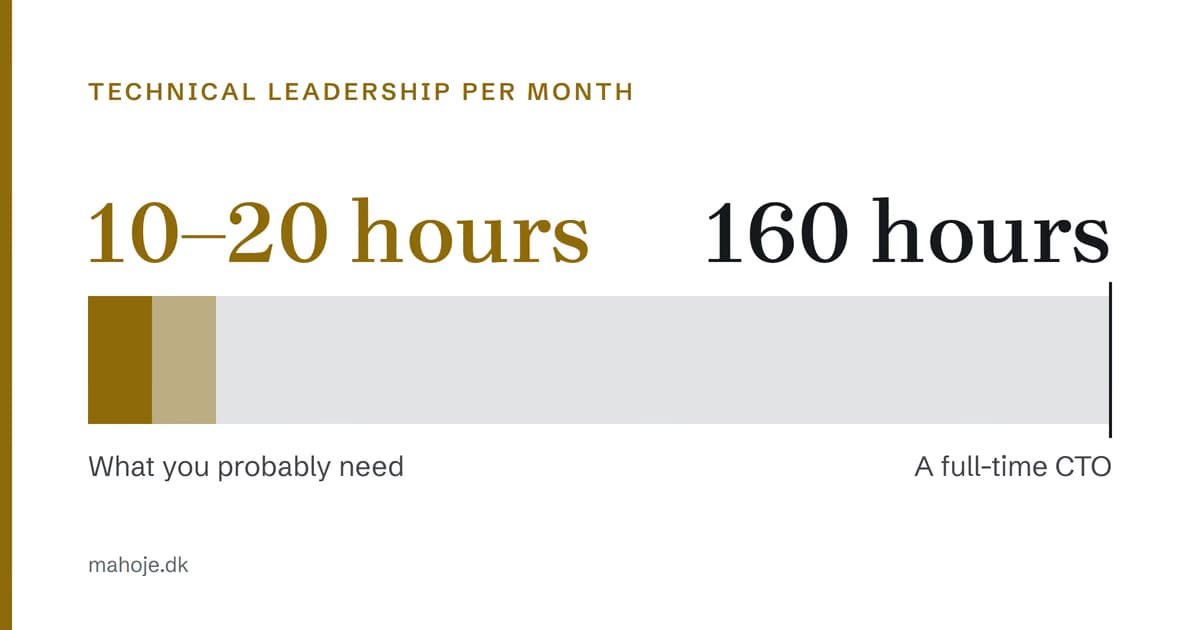
Because a full-time CTO costs DKK 70,000–100,000 a month on the payroll once pension and tax are included. And because your business probably needs 10–20 hours of technical leadership a month — not 160.
It is a classic volume problem. You need the expertise all the time, but the capacity only now and then.
The old answer was the web agency — and that is the problem
The traditional solution has been to let a web agency "take care of it". But an agency has a structural limitation: it sells projects and hours, not leadership.
The agency's finances improve when a new redesign project comes along every other year. Engineering honesty might say "your current site is fine — let's optimise it instead". And when you have several suppliers — one for hosting, one for the site, one for email marketing — none of them owns the whole picture. I have seen the same pattern many times: the site is down, the agency says "it's the hosting", the host says "contact your agency", and the customer is stuck in the middle with a site that is down.
How AI has changed the numbers
This is the interesting part — and the reason I am writing this in 2026 and not in 2020:
A senior person with AI tools can now deliver work that used to require a small team. Not because AI replaces judgement, but because it removes most of the routine work that made specialisation necessary.
Concrete examples from my own working week:
- Code review: AI can read thousands of lines of code and flag security problems, while I judge the things that actually require experience. A full audit of a WordPress site takes hours, not days.
- Monitoring and reporting: Automated checks of uptime, updates, backups and speed are collected into a monthly report — the kind of status that used to be a consultant's billable hours.
- Prototypes: An idea for an internal tool can be working the same day, so we talk about something concrete instead of a requirements document.
- Troubleshooting: When something breaks, AI can narrow down the cause in minutes. I have used it for everything from contact forms that were losing leads without anyone noticing, to plugins that were quietly conflicting with each other.
I have written about my own AI tools and about how I work with AI in the terminal. The point here is the bigger consequence: when one person can cover more ground, small businesses can buy the expertise without paying for a whole team's capacity.
Signs that you need a part-time technical partner
Go through the list. Three or more ticks = you need it:
- You don't know exactly who gets called when your critical system goes down.
- You have received quotes from agencies that you weren't able to assess.
- There is a digital idea (a new tool, an integration, an improvement) that has been on the "one day" list for more than a year.
- Your security strategy is "it'll probably be fine" — and you don't know when your last backup was tested.
- You pay for maintenance or hosting without getting an explanation of what the money goes on.
What it costs in practice
I don't sell a mysterious "it depends on the scope" package. My pricing structure is public, and the track that corresponds to a part-time CTO is called technical partner:
- Drift+ (DKK 10,000/month): All the boringly important things — updates, backups, monitoring, security, a monthly report. The system holds, and you can see that it does.
- Technical partner (DKK 15,000/month): Everything in Drift+ plus the CTO role: I own the technical decisions, assess quotes, prioritise development and am the person you call. Ongoing development with a fixed monthly sparring meeting.
- Complete solution (from DKK 20,000): The entire technical side of the business — design, development, operations, further development — gathered in one place.
For comparison: a full-time CTO starts where the complete solution ends — and you would still be missing a developer.
Conclusion
The question is not whether your business needs technical leadership. It does — at least if it depends on its website, its webshop or its internal systems. The question is whether you want to buy it as a full-time position you can't fill, or as a partner you share.
AI has moved the line for what one person can deliver. That means the technical leadership that used to be reserved for companies with 50+ employees is now available for a fraction of the price — if you choose the right model.
