AI in Danish businesses: what works, and what you should skip
If you search for "AI in business", you get two kinds of answer. Either marketing about autonomous agents that solve everything, or a warning that it is all overhyped. Both are useless to a business with ten employees, because neither answers the only question that matters: what should I actually do with it tomorrow?
Here is the honest answer, based on what I use AI for in my own day-to-day operations work, and on the figures that exist for Danish businesses.
What the figures actually say
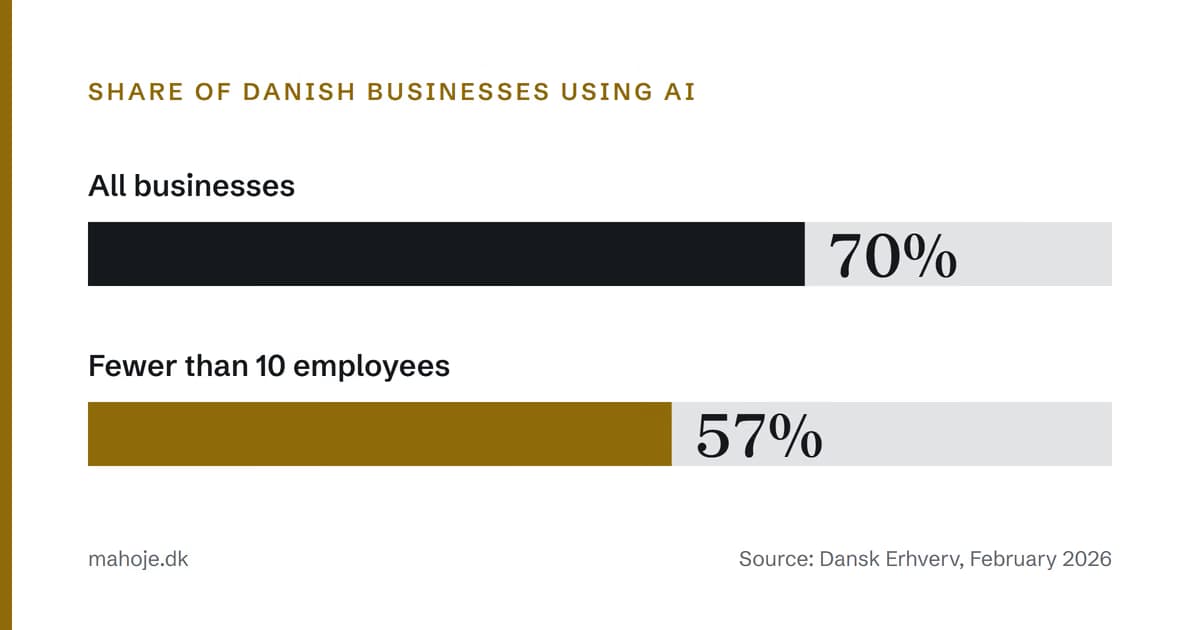
The Danish Chamber of Commerce (Dansk Erhverv) reported in February 2026 that 70% of businesses use AI — but that the figure for businesses with fewer than ten employees is 57%. The difference isn't that small businesses are conservative. It is that they lack the three things the report itself points to: skills, knowledge and time.
Notice the order. It isn't "will" or "budget" that holds businesses with fewer than 10 employees back. It is that there is no one with three hours a week to work out what should be automated, and then test it on a real workflow.
That is why most "AI in business" initiatives stop after a demo. A demo isn't a change to a workflow.
The four tasks that work first
I don't have a complete list of "everything AI can do". I have a list of the tasks that actually made a difference when I started using AI for them in my own operations work — and there are four, not twenty.
1. Troubleshooting when something is broken
A client calls: the form isn't working. Without AI, I spend 20–40 minutes finding the fault — often in a template, a plugin version or a PHP error that makes no sense in the log. With AI, I jump straight to the most likely cause and ask for confirmation.
It isn't a glamorous use, but it is the use that pays off every week. It cuts the response time from "tomorrow" to "now", and it is the only property of AI that has changed my work every single day.
2. Vulnerability review of what is running
I have a fixed sequence I run through when a new WordPress installation or a new plugin goes into production: which files have been written, which versions, which known vulnerabilities, which permissions. It is boring, repetitive work, like clockwork.
AI doesn't make the findings better. It makes it possible to run the list on all your installations instead of only the one I have time for.
3. Technical debt, made visible
Most small businesses don't know how old their code is, how many plugins are installed, or what would happen if they had to change supplier. That isn't a feeling, it is a fact — most of them don't know, because nobody has measured it.
When I review a client's setup, the answer is typically a concrete figure: which plugins, how old, which pages depend on a deprecated function, how many places would need changing if you wanted to switch. AI helps write the list up and prioritise it, but the figures come from the measurement.
4. Training and hand-over
When I set up a new solution, I write it down while I am doing it. It sounds simple, but it is the part that decides whether a client can run things themselves when I am gone. With AI, the writing becomes cheaper, so more things get written down — and more things survive a supplier leaving.
Why it often doesn't work
The same Stack Overflow developer survey from 2025 that I also use in the article about AI tools for WordPress says three things worth reading:
- 84% use or plan to use AI in their development process
- 66% get frustrated with solutions that are almost right
- 45.2% find that debugging AI-generated code takes longer
Notice the third one. AI doesn't just remove work, it moves work. What used to be writing becomes reading, checking and finding errors instead. That is a real and often unnoticed shift in the total workload.
And it explains why the advice "just start with AI" so often fails in a small business. Without someone who can assess a result, you just move the errors from your writing process to your checking process — and your checking process is the one you don't have people for.
The list you should skip
This is the part I am most often asked to help companies get out of. Each one is something that has been sold to Danish businesses over the last two years:
An AI chatbot on the website because "everyone has one". It answers questions nobody asks and doesn't pass on a single enquiry. It is expensive to run and its measurable effect is zero.
Automating the process that doesn't work. First find the task that gets faster because it is worth doing. Automate it afterwards. Otherwise you are automating a bottleneck.
AI writing your blog content because you "lack content". You get 60 articles nobody reads, and a risk that Google regards the whole domain as thin. Content isn't a quantity; it is answers to questions your customers actually ask.
A platform judged on a couple of accounts alone. It has to be able to answer: what does it cost per month, what happens the day the account is closed, and where is the data stored. If those three questions can't be answered in writing, you don't have a platform, you have a supplier dependency.
A generic chatbot that sends your customers on to your competitor. Found in a surprising number of Danish AI projects right now.
What it actually costs to get started
Here I would rather be concrete than optimistic.
If all you do is have one workflow looked over by an outsider, and then run it yourselves, it is a few hours' work. If you want an overall assessment of your setup — what is running, what is debt, what should be changed and in which order — it is a small project, not a consultancy day.
If you want it maintained, secured and continuously improved, we get into the part of the model called technical partner. It is built on exactly the premise that there is no internal IT team: that responsibility for the technical side sits somewhere, and that it sits there permanently.
All the prices are on the pricing page, so you can see the whole structure before you talk to anyone.
Conclusion
70% of Danish businesses use AI. That doesn't mean you have to. It means your competitors do, and that the gap in your market is shrinking.
The difference isn't in which tool you choose. It is in whether you have done the work of finding out what is actually worth automating in your business — and whether there is someone who takes responsibility for the answer afterwards.
