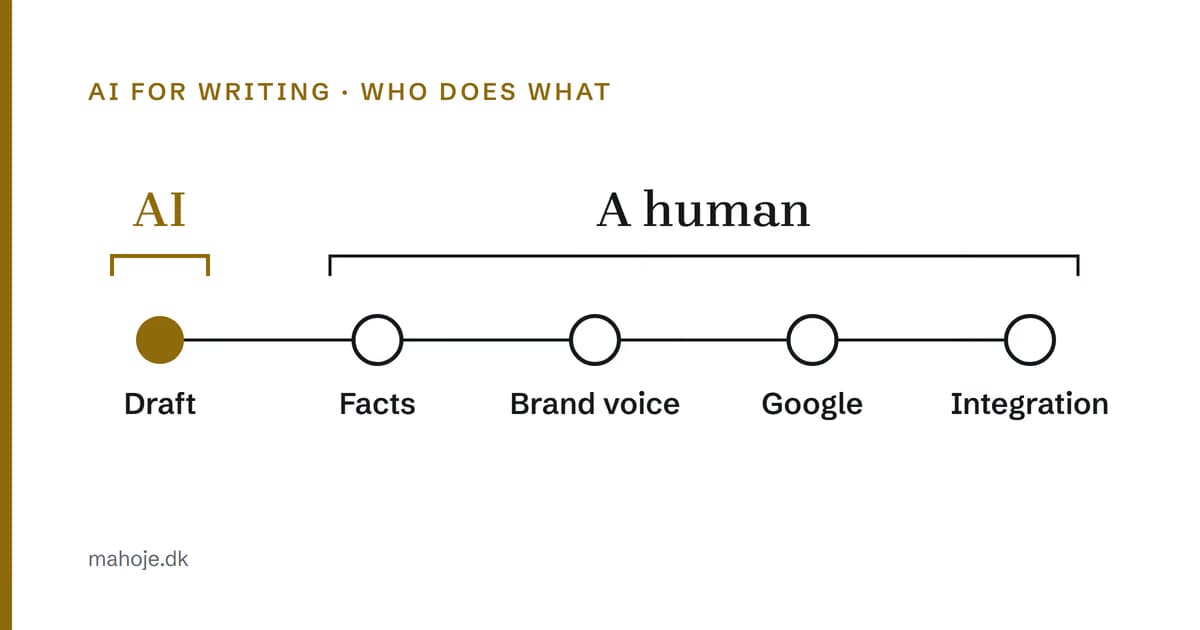
AI for writing: what the tool can handle on its own, and what needs a human
"AI for writing" is one of the most searched-for questions about AI right now. But it is the wrong question.
The right question isn't "which AI should I use?". It is: what happens to the text once it has been written?
Because that is where most people come unstuck. Not at the writing — the tool handles that fine. But at everything that comes afterwards.
Short answer
AI can write drafts. It does so quickly and cheaply. But quality control, brand voice, facts and integration with your systems are human tasks. And those are the ones that cost.
What AI can write
Four areas where the tool does well:
Product descriptions. A webshop with 200 products needs 200 descriptions. AI can write them in an afternoon. It is a task that used to take a week, and which is now a formality.
Meeting notes. A meeting that lasts an hour and needs minutes. AI can write the notes so they are ready when the meeting ends. It is the most obvious use of AI for writing, because the notes don't have to be beautiful — they have to be correct.
Translation. A text that needs to go from Danish to English. AI can translate it in a minute. It is really good for understanding the content. It isn't good enough to publish.
Newsletters. A draft of a newsletter. AI can write it so you have something to improve. It is the fastest way to get started on a newsletter you would otherwise never get written.
Where it goes wrong
Four things that go wrong when AI writes for you:
Factual errors. AI makes things up. It doesn't do it to fool you — it does it because it is good at writing plausible text and bad at knowing your circumstances. An AI writing about your business doesn't know what you do, what you are allowed to say, or what you are allowed to promise.
Brand voice. AI writes like AI. It is recognisable: too generic, too positive, too uniform. And that is what makes your texts look like everyone else's. Your voice is what sets you apart — and AI can't copy it, because it comes from you.
Google. Google has a spam policy called "scaled content abuse". It says that content generated "for the primary purpose of manipulating search rankings and not helping users" is spam. Large amounts of unoriginal content, "no matter how it's created", falls into that category (Google Search spam policies). That doesn't mean AI content is banned. It means that texts that are only there to fill space can harm your whole site.
Integration. The text has to go somewhere. A product description has to go into your webshop. Meeting notes have to go into your task. A newsletter has to go into your newsletter system. And this is where it gets technical. Because AI doesn't write in your webshop. It writes in a box, and you copy it into your webshop.
When you need a technical partner
Three signs that you need more than a tool:
You write texts regularly. If you write product descriptions every week, or a newsletter every month, it is a process, not a one-off task. And processes need someone who knows how they fit together.
The texts have to go into your systems. If you have to copy texts from the AI into your webshop, your CRM or your newsletter system, that is a technical question. And that is where you save a lot of time — not in the writing.
You have to be able to stand behind it. If a customer asks why something specific is on your site, you need to be able to answer. That requires someone to know what has been written, and why.
The four questions to ask
Before you choose between a tool and a partner, answer these:
- How much do you write? One text is a tool question. Texts every week are a process.
- Where does the text need to go? In a box, it isn't usable. In your system, it is.
- Who checks the quality? If it is you, then you are the one spending the time. If it is someone else, you need to know what they check.
- Who is responsible? If a text is wrong, who does the customer call?
Conclusion
AI for writing isn't a question of tools. It is a question of what happens afterwards.
The tool can write the draft. But the draft has to be checked, adapted, integrated and maintained. And those are human tasks.
If you only write one text, use the tool. If you write texts regularly and they have to go into your systems, it is a technical partner question — and that is where technical partner and the prices come in.
