AI consultant: prices, hourly rates and what you get
If you search for "AI consultant", you get two kinds of results. One is job adverts: an AI consultant for a local council, AI consultant salaries, AI consultant jobs in the capital. The other is agencies selling "AI strategy" as a PDF and a workshop.
But the searches that actually end in a purchase look different. In Danish they are the equivalents of ai consultant prices, ai consultant price list, ai consultant hourly rates and ai consultancy. They are not questions about what a consultant is called or where they work. They are questions about what it costs, and what you get for it.
This article is written for that kind of question. It only uses the prices already published on this website, so you can look them up and check.
First: what an AI consultant actually is
An AI consultant is the person who puts artificial intelligence to work in your business — and who carries the responsibility for it working afterwards.
That last part is the whole difference. There is no big difference in using AI: for that, you can pay 20 kroner for a subscription. The difference is what happens when the tool wrote an email to a customer, an integration broke on a Tuesday morning, or a plugin update broke an integration nobody has touched in eight months.
A consultant takes a position on three things you can ask about:
- Access. Who is allowed to log in to your server and your systems? With me, the answer is you, and it is written down as such.
- Monitoring. Who notices when something has gone wrong — before a customer does?
- Error handling. Who fixes it, and who decides how?
If you ask a vendor about those three and get an answer to two, you don't have a consultant. You have a subscription service.
What AI consultants actually get paid for
Search suggestions show that Danes search for ai consultant prices and ai consultant hourly rates. That is because the market is hard to make sense of: some sell by the hour, others by the project, others in "strategy packages" with no price.
Here are the three usual ways it is done, and what each is good for.
Hourly rate — for work with clear boundaries
An hourly rate is right when the job is one job: a bug to be found, a performance problem to be measured, an integration error after a plugin update. It is known, it has a start and an end, and it can be defined as not ongoing.
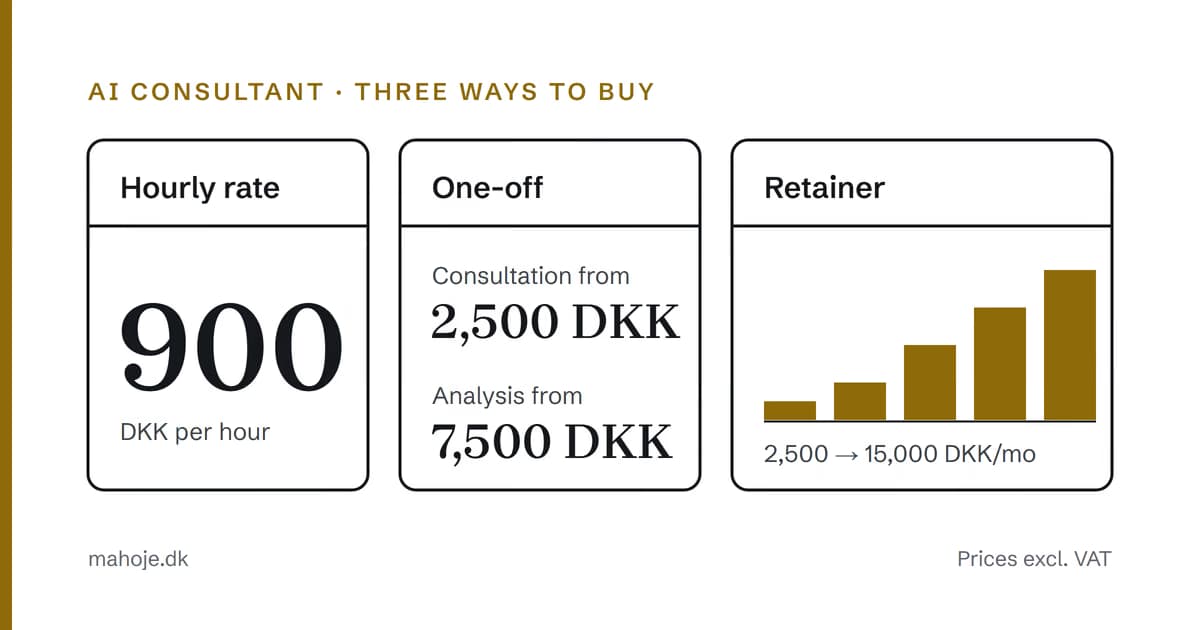
My hourly rate is 900 DKK/hour excl. VAT. It is the same rate whether the job is WordPress, AI or something else.
An hourly rate is not the same as an agreement. It says nothing about what happens when a new error appears a month later.
One-off purchase — for things that need assessing
A consultation or an analysis is bought once and delivers an assessment you act on yourself.
This website lists two specific levels:
- A single consultation from 2,500 DKK. You ask questions, you get an answer.
- An in-depth analysis from 7,500 DKK. You get a thorough picture with priorities.
It is the cheapest place to start if you are facing a decision. A migration, a platform change, or whether to invest in AI at all. Pay for the answer, not for a programme.
Retainer — for things that keep running
Once AI simply is part of your operations, the hourly rate stops making sense. Then you buy responsibility, not hours.
These are the prices on this website, the same in Danish and English:
| Level | Price | What it is |
|---|---|---|
| Micro | 2,500 DKK/mo | Operations and updates for one site |
| Light | 5,000 DKK/mo | Ongoing support and small improvements |
| Drift+ | 10,000 DKK/mo | Continuous development and optimisation |
| Technical partner | 15,000 DKK/mo | Dedicated CTO access across the whole stack |
| Complete solution | From 20,000 DKK | A new solution built and run in one place |
All five are on the pricing page, and they are the prices I actually charge.
Why an hourly rate is the worst way to buy AI
Not because the hourly rate is expensive. Because it moves the risk to you without saying so.
Here is the pattern I see again and again: a business buys a block of hours, gets a solution built, and it works for three months. Then something goes wrong — a certificate expires, a backup doesn't run, a plugin update breaks the link between the website and the CRM.
The customer calls. And it turns out the agreement only covered the day the solution was built.
That is not wrong. It is just a different product from the one most people think they are buying. And that is why I would rather have a customer on a retainer, where I am the one answering the phone three months later.
Three signs you don't need an AI consultant
It is not in my interest to write this section. But an AI consultant who can be sold to everyone is a salesperson, not a consultant.
You need one if AI has become part of your operations — that is, if something customer-facing that brings in money is connected to something you have automated. Or if you are facing a decision you cannot assess on your own.
You probably don't need one if:
- You just want a chatbot. It can be set up for a few thousand kroner and handed over. It may be a bad idea, but it is not a consulting job. Whether a chatbot is worth paying for is a question for another article.
- You have no idea what should be automated. Then an hour is the right purchase, not an agreement. Get an assessment and work it out before you commit to anything.
- You have a capable person in-house. If you already have a developer or IT lead who is good and has the time, you are better off than with a consultant on top. What you need then is someone to spar with, and that can be an hour.
Tell me if it is point 2 or 3. I am happy to take an hour, and you walk away again.
What an AI consultant should be able to answer
If you are comparing quotes from several, use this list as a checklist. It is based on what actually decides whether an AI project holds up:
- Who has access to what? Name the systems, not the word "access".
- What is monitored, and where can I see it? If the answer is "we keep an eye on it", ask when.
- What happens when something goes wrong at seven in the morning? Does someone need to be on call, or is the next working day fine?
- Who owns the code? If the vendor owns it, you cannot switch.
- What does it cost to stop? An agreement without an exit you can actually use is a lock, not an agreement.
- What if the tool disappears? A model, a plugin or a platform that shuts down is not a hypothetical question.
A vendor who answers all six is a consultant. One who answers the first and goes quiet on the rest is selling hours.
What it costs with me, specifically
No caveats, no "price on request":
- Ad hoc tasks and advice: 900 DKK/hour excl. VAT.
- Single consultation: from 2,500 DKK.
- In-depth analysis: from 7,500 DKK.
- Micro, Light, Drift+, Technical partner, Complete solution: 2,500 → 15,000 → from 20,000 DKK/mo. All five, with prices, are on the pricing page.
If you are unsure which one fits, let the site show you: press the button, answer two questions, and you get a recommendation with a price. Or write to me with two lines about what is bothering you.
Worth reading next
- AI automation: what you can automate, and what it costs — the five tasks that pay off first, and two that rarely do.
- AI agents in 2026: from hype to reality — what agents actually do today, and what the data says.
- Technical partner — what it means to have one person responsible for the whole stack, and what it costs.
Sources
- Prices: all figures in this article are on mahoje.dk's own pricing page and contact page. They are not taken from the market, and they are not an average of other people's prices.
- Technical limits: Anthropic's own documentation on hallucinations states plainly that a language model can make things up, and that output must be checked before it is used. That is why a consulting job cannot end at "the AI wrote it". Read on 29 September 2026.
