If you run a webshop or take orders from private customers on your website, there has been a requirement since summer 2025 that the site must be usable by people with disabilities. Many owners have heard about it but don't know whether it applies to them, or what it means in practice.
This article is written for businesses operating in Denmark or selling to Danish consumers. The rules come from the EU's European Accessibility Act, which every member state has written into its own law; what follows is the Danish version, as I have found it in the law and at the authorities, written for you who need to decide something and don't want to read legal text. Every claim links to its source, and most of the Danish sources are only available in Danish. This is not legal advice: if you are unsure about your own situation, ask a lawyer or the Danish Business Authority (Erhvervsstyrelsen).
In brief
- Private businesses are covered by the Danish Accessibility Act (tilgængelighedsloven), which applies to certain services and products for consumers from 28 June 2025. For most small and medium-sized businesses, the relevant part is e-commerce services: websites and apps where a consumer can enter into an agreement, for example buy a product or a service.
- If you only sell to other businesses, your site is not covered, writes the Danish Business Authority.
- Microenterprises are exempt when they provide services. That requires fewer than ten employees and an annual turnover or balance sheet total of no more than EUR 2 million (section 3(19) and section 6(3)).
- Public authorities follow a different law, the Web Accessibility Act (webtilgængelighedsloven), and they are the ones who need an actual accessibility statement.
- In practice, the requirements mean the site must be usable with a keyboard, zoomable, readable by a screen reader and have sufficient contrast. The Danish Business Authority refers to the WCAG 2.1 guidelines.
Two laws that sound alike
There are two Danish laws on accessibility online, and they are often confused.
The Web Accessibility Act: the public sector
The Act on the accessibility of public sector bodies' websites and mobile applications applies to authorities and bodies governed by public law. It entered into force on 23 September 2018, and the Danish Agency for Digital Government (Digitaliseringsstyrelsen) supervises it. Sites are considered compliant if they meet the EN 301 549 standard, whose requirements for web pages mainly refer to WCAG 2.1.
If you are a private business, this is not the law that applies to you. It is, however, the reason so many people search for "accessibility statement", and I will come back to it below.
The Accessibility Act: private businesses
The Act on accessibility requirements for products and services implements the EU accessibility directive, Directive (EU) 2019/882, also known as the European Accessibility Act. The law entered into force on 28 June 2022, but it only applies to products and services placed on the market or provided from 28 June 2025 (sections 58 and 59).
Among other things, the law covers computers, payment terminals, banking services, e-books and e-commerce services (section 1). It is the last item that affects most ordinary businesses.
Is your business covered?
Three questions decide it for most. I have gathered them in the diagram here, and the explanation follows below.
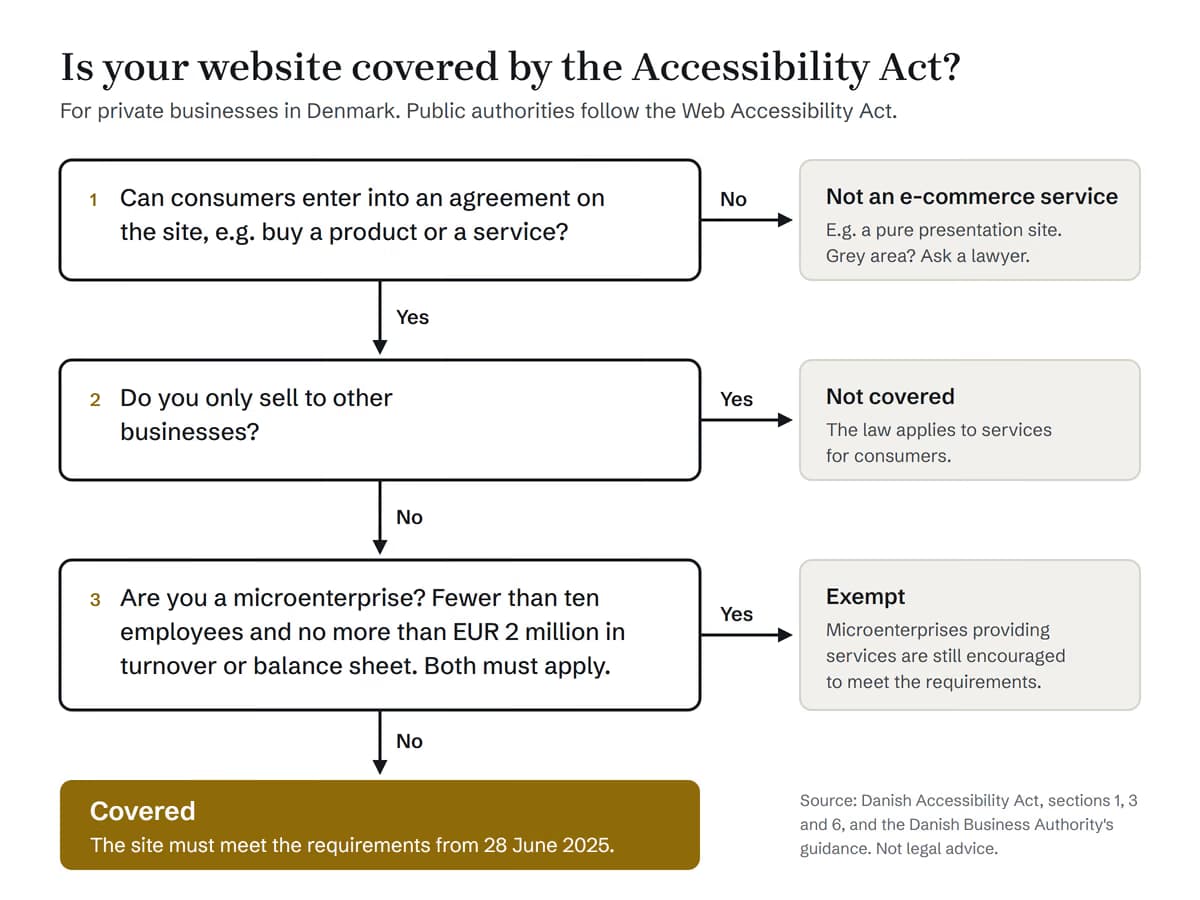
Can consumers enter into an agreement on your site?
The law defines an e-commerce service as a service provided electronically via websites or apps "at the individual request of a consumer with a view to concluding a consumer contract" (section 3(26)). The Danish Business Authority translates that into websites and apps "where consumers can enter into an agreement on, for example, the purchase of goods or services".
So a webshop is covered. In my reading, the same applies to a site where private customers can order and pay for a service. A pure presentation site, where the customer can only read and send a message, falls outside the definition in my reading, because no agreement is entered into on the site. If your site is in a grey area, this is where you should ask a lawyer.
Do you only sell to other businesses?
Then you are not covered. The law applies to services for consumers, and a consumer is a natural person acting outside their trade or profession (section 3(18)). The Danish Business Authority states directly that e-commerce services provided solely to businesses are not covered.
Are you a microenterprise?
Microenterprises that provide services are fully exempt from the accessibility requirements (section 6(3); Article 4(5) of the directive). The law defines a microenterprise as a business with fewer than ten employees and an annual turnover or annual balance sheet total of no more than EUR 2 million.
The Danish Business Authority's guidance adds three things worth knowing:
- Employees are counted in full-time equivalents. Eleven part-time employees can easily be fewer than ten full-time equivalents.
- Both conditions must be met: few employees and low turnover or balance sheet total.
- It is the most recently closed financial year that counts, and you only change status when two consecutive sets of accounts show the change.
The authority also encourages microenterprises to meet the requirements as far as possible.
What if the shop existed before 2025?
That doesn't help. According to the Danish Business Authority, all e-commerce services provided to consumers from 28 June 2025 must meet the requirements, even if they existed before. The law has transitional rules; for example, contracts for services concluded before 28 June 2025 can continue unchanged until they expire, but no later than 28 June 2030 (section 59). That is not a general postponement for existing webshops.
Exemptions for disproportionate burdens
Businesses that are not microenterprises can also be exempted from individual requirements if the requirement would mean a fundamental change to the service, or if it would impose a disproportionate burden (section 8). The assessment must be made requirement by requirement, documented and kept for at least five years, and you must notify the supervisory authority if you rely on the exemption (sections 9 and 12). It is an exemption you must be able to defend with figures, not a shortcut.
What does the law require of a webshop?
The requirements are in Annex 1 of the law, and the Danish Business Authority sums them up in four words. The site must be:
- Perceivable, for example with image descriptions, captions and sufficient contrast.
- Operable, for example so you can navigate with a keyboard and pause rotating content.
- Understandable, so navigation and information are presented logically.
- Robust, so the site works in all browsers and screen readers can read the content correctly.
For e-commerce, three specific requirements come on top (Annex 1, Section 4, point g):
- You must pass on information about the accessibility of the products you sell, when the manufacturer has provided it.
- Login, security and payment must be accessible, including when they are provided by an external solution, writes the Danish Business Authority.
- Identification, electronic signatures and payment must be perceivable, operable, understandable and robust.
Finally, you must describe the service and explain how it meets the requirements (section 35 and Annex 4). According to the Danish Business Authority, the accessibility information must be given before the customer enters into an agreement.
Which standard should you follow?
The Danish Business Authority's questions and answers state that there is not yet a harmonised standard linked to the directive, and that as a starting point you can meet the requirements by following the WCAG 2.1 guidelines. In a presentation at the Danish Agency for Digital Government in June 2026, the authority names EN 301 549 and WCAG 2.2 as the best way to meet the requirements.
That is easier to deal with than it sounds. WCAG 2.2 is the newest version, and it is backwards compatible: a site that meets 2.2 also meets 2.1. For the public sector, WCAG 2.1 at level AA applies, according to W3C. If you aim for WCAG 2.2 at level AA, you are, in my assessment, in the best place to be.
The Danish Business Authority itself gives two concrete examples from WCAG 2.1 (questions and answers):
- Normal text must have a contrast ratio of at least 4.5:1 against the background, large text at least 3:1.
- Text must be zoomable to 200 per cent without content or functions disappearing.
The latter is closely linked to responsive design: a site that already adapts to the screen has a better starting point for being zoomed.
It is your responsibility, not the platform's
If you use an off-the-shelf webshop solution, you are still the one responsible under the law. The Danish Business Authority writes that the company that developed the solution is not the responsible service provider, and that you may therefore have to work together to meet the requirements.
Accessibility statement: who needs one?
Public authorities must publish and keep updated a "detailed, comprehensive and clear accessibility statement" (section 4 of the Web Accessibility Act). The Danish Agency for Digital Government provides the WAS-Tool for this, the statement must be updated at least once a year, and there should, as far as possible, be a link to it in the footer.
Private businesses do not have that requirement. In the presentation from June 2026, the Danish Business Authority writes that the Accessibility Act does not require a separate accessibility statement. Instead, under Annex 4 you must provide the information "in the general terms and conditions or an equivalent document":
- a general description of the service in accessible formats,
- the explanations needed to understand how the service is used,
- a description of how the service meets the accessibility requirements.
My practical advice is to gather the information on one page, linked from the footer and from your terms of sale. Whether you call the page "Accessibility" or "Accessibility statement" is up to you. What matters is that the content is there, and that it is true.
What happens if the site does not meet the requirements?
Supervision of e-commerce services lies with the Danish Business Authority, which the Danish Safety Technology Authority (Sikkerhedsstyrelsen) became part of in January 2026. It supervises on behalf of the Danish Competition and Consumer Authority.
According to the authority's presentation, supervision is both proactive and based on tip-offs from consumers, using manual user tests and testing tools. Consumers can bring a case to the authority themselves (section 55).
If the authority finds errors, it can order them fixed within a deadline, and if that does not happen, it can order sales to stop (section 49). Breaches can be punished with a fine (section 57). The authority describes its own approach as pragmatic and dialogue-based, with a focus on guidance and orders, while deliberate or repeated breaches can lead to a police report and a fine.
How to check your own site
You can get a long way in an hour without being technical. The order below is based on W3C's Easy Checks, W3C's own list of quick checks, and on the Danish Business Authority's examples.
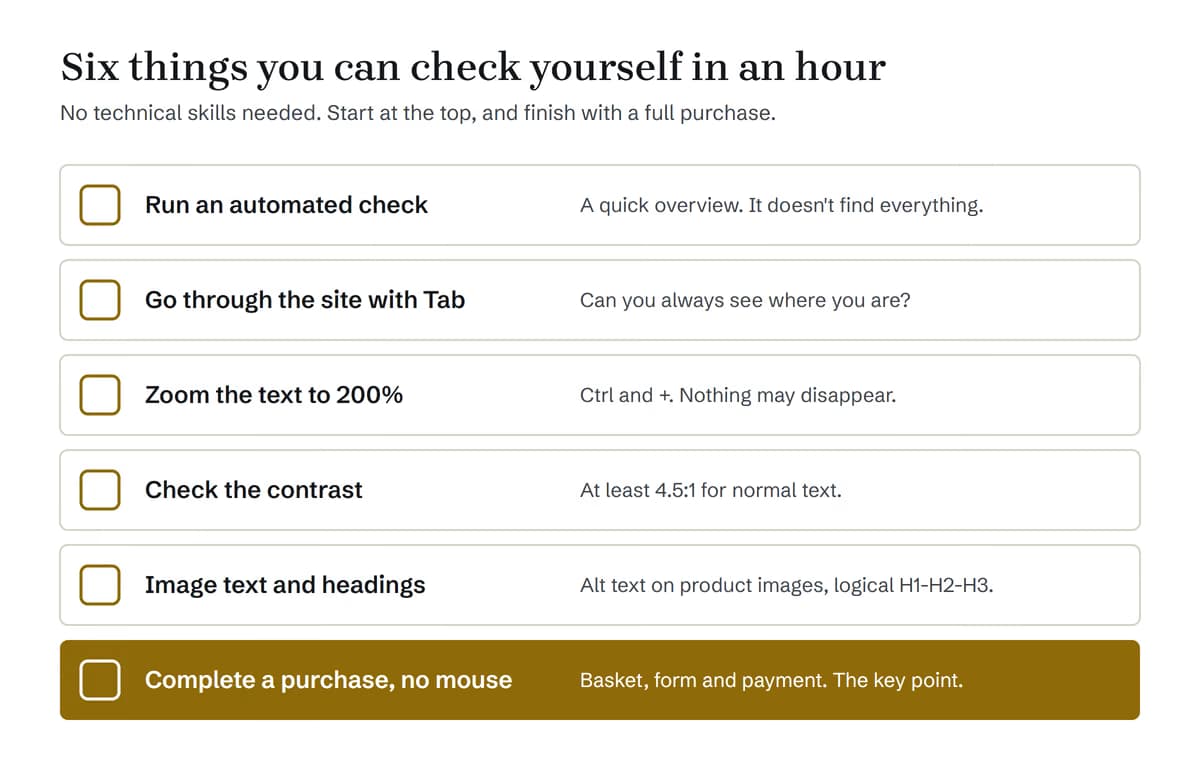
- Run an automated check. My free website check (in Danish) measures accessibility, among other things, with Google's Lighthouse and gives you a score and a list of errors. It is the fastest place to start, but remember W3C's caveat: tools cannot determine whether a site is accessible, they can only help with it (W3C).
- Put the mouse away. Press the Tab key and go through the site. Can you see where you are? Can you reach the menu, the search field and the buttons?
- Zoom the text to 200 per cent with Ctrl and + (Cmd and + on a Mac). This is the Danish Business Authority's own test. No content may disappear.
- Look at the contrast. Light grey text on a white background is a classic example. The requirement is 4.5:1 for normal text.
- Check images and headings. Product images need a text a screen reader can read aloud, and the page must have a logical heading structure with H1, H2 and H3, which W3C also mentions in Easy Checks.
- Complete a full purchase with the keyboard. From the product to the basket, through the form and the payment. Form fields must have visible labels (W3C), and payment is explicitly mentioned in the law's requirements.
Point 6 is the most important, and it is the one an automated tool cannot do for you. If a customer cannot pay without a mouse, a high score does not help much.
What I would do if it were my webshop
- Establish whether you are covered. Check the number of full-time equivalents and the turnover in your two most recent sets of accounts. If you are a microenterprise, you are not obliged, but it is still good business to be able to serve every customer.
- Fix the errors the machine finds. Missing image text, low contrast and form fields without labels can often be fixed without rebuilding anything.
- Test the checkout with keyboard and zoom. This is where the customer loses the ability to buy if something fails, and the fault may be in the theme or in a payment solution you did not build yourself.
- Write the accessibility information. Describe the service, how it is used and how it meets the requirements, and link to the page from your terms of sale.
- Make it part of operations. The law requires you to have procedures that ensure the service continues to meet the requirements (section 36). A new plugin or a new theme can break what worked yesterday.
The last point is where many small businesses stall, because nobody owns it. That is the kind of thing I take care of as a technical partner, and you can see what it costs without having to book a meeting first.
Frequently asked questions
Do the web accessibility requirements apply to my company's website?
If you are a private business, the Danish Accessibility Act applies to your website if consumers can enter into an agreement on it, for example buy a product or a service, and you are not a microenterprise. If you only sell to other businesses, the site is not covered. Public authorities are covered by a different law, the Danish Web Accessibility Act.
When did the requirements take effect?
The Accessibility Act entered into force on 28 June 2022, but the requirements apply to services provided from 28 June 2025. According to the Danish Business Authority, this also applies to webshops that existed before that date.
Are small businesses exempt?
Microenterprises that provide services are exempt. A microenterprise has fewer than ten employees (the Danish Business Authority counts full-time equivalents) and an annual turnover or balance sheet total of no more than EUR 2 million. Both conditions must be met.
Do I need an accessibility statement?
Public authorities must have an accessibility statement under the Web Accessibility Act. The Accessibility Act does not require a separate statement from private businesses, but in your general terms and conditions or an equivalent document you must describe the service and explain how it meets the accessibility requirements.
Which standard should my website meet?
The Danish Business Authority writes that there is not yet a harmonised standard for the directive, and that as a starting point you can meet the requirements by following WCAG 2.1. In a presentation from June 2026, the authority points to EN 301 549 and WCAG 2.2. WCAG 2.2 is backwards compatible with 2.1.
Who supervises, and can you be fined?
The Danish Business Authority supervises e-commerce services on behalf of the Danish Competition and Consumer Authority. It can issue orders with a deadline, and the law allows for fines. The authority itself describes an approach based on guidance and orders, where deliberate or repeated breaches can lead to a police report and a fine.
Can an automated tool tell me whether my site is accessible?
No, not on its own. An automated check finds many errors quickly, but W3C writes that tools cannot determine whether a site is accessible, only help with it. You also need to test the site yourself, for example with the keyboard and by zooming the text.
Sources
All sources were read on 1 October 2026. Danish-language sources are marked (in Danish).
- Act no. 801 of 7 June 2022 on accessibility requirements for products and services (the Accessibility Act), Retsinformation (in Danish): retsinformation.dk/eli/lta/2022/801
- Act no. 692 of 8 June 2018 on the accessibility of public sector bodies' websites and mobile applications (the Web Accessibility Act), Retsinformation (in Danish): retsinformation.dk/eli/lta/2018/692
- Directive (EU) 2019/882 of the European Parliament and of the Council on the accessibility requirements for products and services, EUR-Lex: eur-lex.europa.eu
- European Commission: European Accessibility Act (EAA): commission.europa.eu
- Danish Business Authority: E-commerce services (in Danish): sik.dk
- Danish Business Authority: Accessibility, exemptions and microenterprises (in Danish): sik.dk
- Danish Business Authority: General information on the requirements of the Accessibility Act (in Danish): sik.dk
- Danish Business Authority: Questions and answers on accessibility for products and services (in Danish): sik.dk
- Danish Business Authority: Authorities responsible for accessibility supervision (in Danish): sik.dk
- Danish Business Authority: Presentation on the Accessibility Act, Danish Agency for Digital Government, 16 June 2026 (PDF, in Danish): digst.dk
- Danish Agency for Digital Government: Legislation on web accessibility (in Danish): digst.dk
- Danish Agency for Digital Government: About the accessibility statement (in Danish): digst.dk
- Danish Agency for Digital Government: Understanding the technical standard (in Danish): digst.dk
- W3C: WCAG 2 Overview: w3.org
- W3C: Web Accessibility Laws & Policies, European Union: w3.org
- W3C: Easy Checks, A First Review of Web Accessibility: w3.org
- W3C: Selecting Web Accessibility Evaluation Tools: w3.org